R744 (CO2) Freezer Case Study
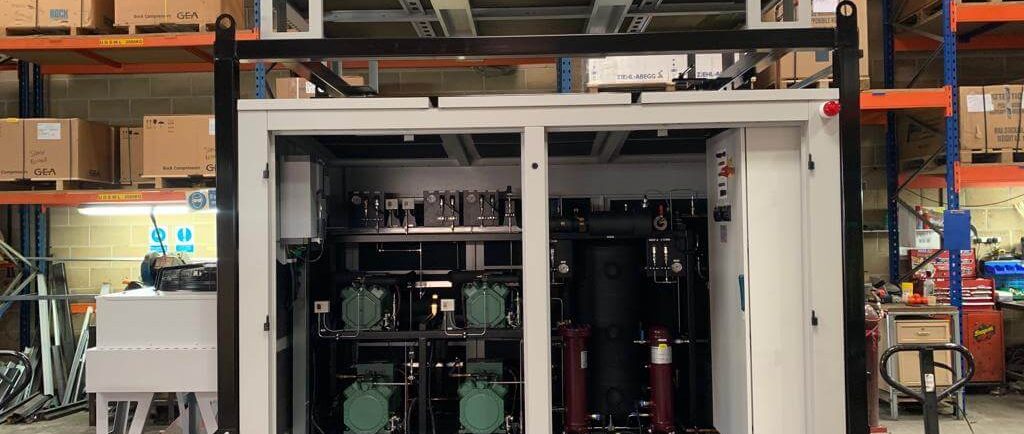
R744 (CO2) Freezer
Project Brief:
- Ice Cream Store Room (-30°C Room Temperature).
- Total Cooling Load – 112kW Evaporating at -37°C.
- Total Cooling load to be split across two packs.
- Each pack to serve two evaporators.
- All pack and evaporator controllers to be Danfoss.
- Pack to have full back up control.
- Packs to be externally mounted.
- Very Limited plant space on site.
Design
Being a single temperature LT freezer system, the pack design would need to be a two stage system. The client had specified Bitzer machines so we began by making the compressor selections. As there were to be two packs on site, we settled on each pack having 2 x low stage subcritical machines and 2 x high stage Transcritical machines. The compressor selections allowed us to size the low stage intercooler and the gas cooler.
The plant space restrictions on site meant that the gas cooler would have to be mounted on top of the plant enclosure, so its final dimensions would be key in deciding the overall plant footprint. We ended up with a 2 fan gas cooler per pack and a small single fan low stage intercooler.
The selection of these main key components allowed us to size the final enclosure and the pack frame.
We then created a detailed parts and instruments drawing (P&ID) to finalise the receiver vessel, accumulator, pipe sizes and controls and to ensure a smooth sign off with our notified body under the PED.
Build
Once all the main components had arrived, the methodical build process began, paying particular attention to each component position to ensure ease of maintenance once the pack had been completed. Constant liaison between skilled workshop technicians and the design team ensured the build stayed on track and any issues were quickly resolved.
The placement of the gas cooler was not ideal when it came to accessibility for maintenance but the site restrictions gave no option to engineer this out. However, the onsite technician had access to mobile working platforms and it was agreed their use would be written into the onsite maintenance procedure.
Evaporators and Pipe work
We carried out selections for the cold room evaporators and their associated stepper control valves. This ended up being two twin fan evaporators supplied by Roller per pack. We also supplied the evaporator control panels complete with Danfoss controller and stepper module.
Once a pipe route had been agreed upon, we carried out the pipework design and sized the pipes accordingly. With a liquid line maximum working pressure of 52bar and a low stage suction side maximum working pressure of 31bar, it was possible that standard copper could have been used for the installation, but the client opted to use K65 copper throughout with an MWP of 80bar. We had already piped the discharge line in 120 bar K65.
On Site Support
We made sure that the installing contractor had all the support that they needed. We assisted them with the commissioning and set up of the system and spent several days on site providing them with commissioning sheets once the plant was up and running. We also assisted them with the PED certification of the system as this was their first CatIV install. This included specifying tightness and strength test pressures and providing various document templates that could be used (pressure test certificates, Declarations of Conformity).
Training
The onsite technician had undergone basic training in CO2 systems but had not had to work on or maintain one before. We worked with him throughout the commissioning process and provided plant specific training to assist him with his ongoing maintenance duties.
Plant Costs
We carried out a costing exercise for the client to ensure they had all the correct information to back up their decision to use R744 (CO2) as the refrigerant of choice. CO2 plant for this type of application showed a significant increase in cost.
Working with the install contractor we were able mitigate some of this cost. For example, the power requirements per pack reduced from a required 250amp per pack on HFC to 150amp per pack on CO2. The refrigeration pipe sizes for CO2 are also a lot smaller than HFC which can contribute to a cheaper install.
Legislation
Under current legislation (The F-Gas Regulation) the client did not need to use R744 (CO2), but the decision was made to support their environmental policy and to future proof them against future legislative change.
From January 2022, under F-Gas Law, this installation would have had to use a refrigerant with a global warming potential lower than 150 as it exceeds 40kW and evaporates above -50°C.